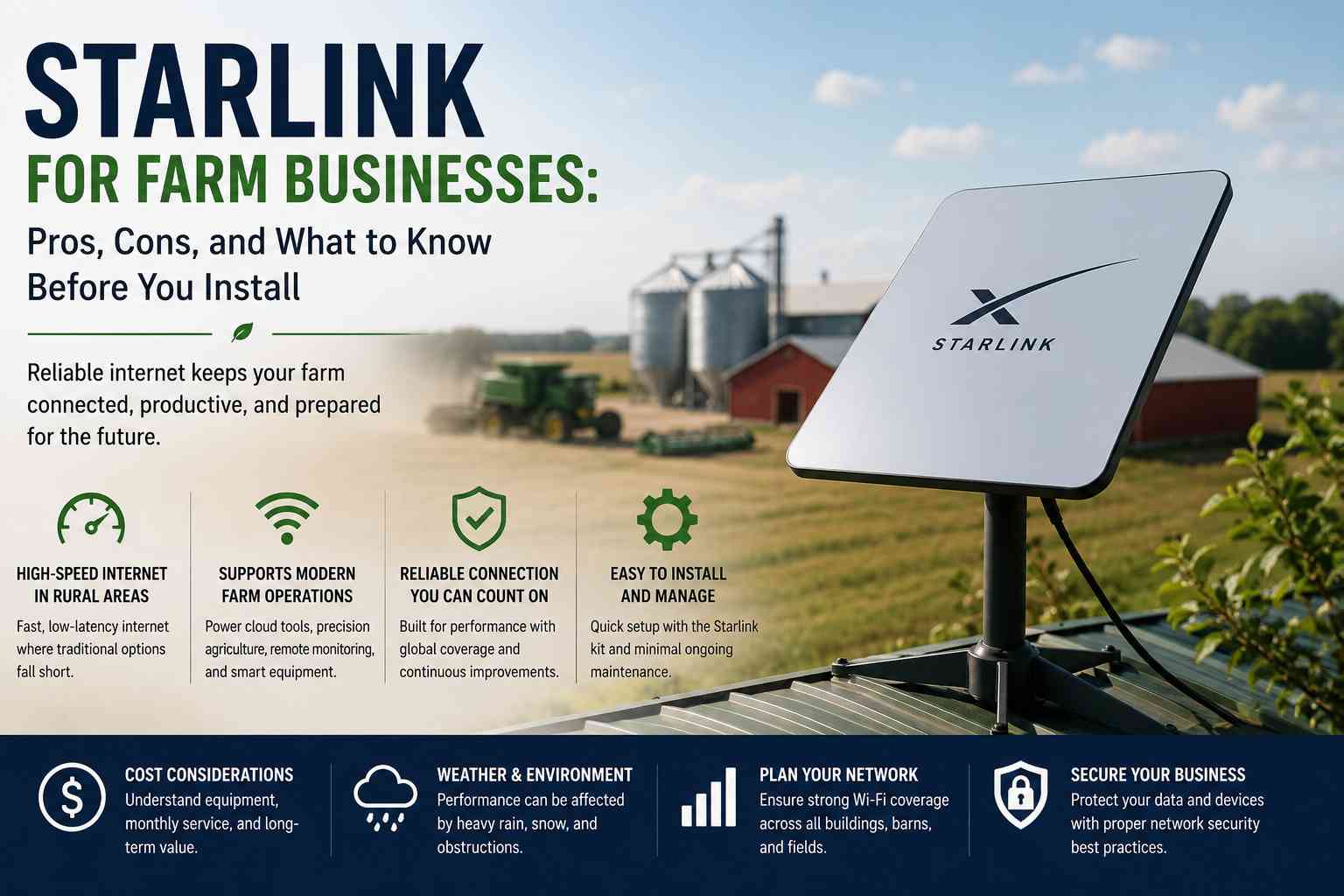
Starlink for Farm Businesses: Pros, Cons, and What to Know Before You Install
Why Farm Businesses Are Looking at Starlink
Reliable internet has become a business requirement for modern farms. Farm owners and managers increasingly depend on cloud-based accounting, equipment diagnostics, security cameras, remote monitoring, weather data, online parts ordering, livestock systems, irrigation controls, grain marketing platforms, and precision agriculture tools.
When a rural property has limited cable, fiber, or cellular coverage, even basic daily operations can become harder than they should be.
That is why many farm businesses are considering Starlink, SpaceX’s low-earth-orbit satellite internet service. Compared with older satellite internet options, Starlink is known for higher speeds and lower latency, making it more practical for video calls, remote
monitoring, file uploads, and business applications. For farms located beyond the reach
of dependable wired broadband, Starlink can be a strong option. However, it is not perfect for every operation, and it should be evaluated carefully before installation.
Starlink can be a valuable connectivity tool for farms, but the best results usually come from treating it as part of a complete farm network plan rather than simply plugging in a dish and hoping every building, camera, and device works correctly.
The Bigger Connectivity Problem in Agriculture
Agriculture is becoming more data-driven every year. The FCC and USDA’s Precision Agriculture Connectivity Task Force describes the industry as moving toward a connected, digital, data-driven business model, with broadband playing a key role in supporting
resilient and sustainable production. The same report emphasizes the importance of
“last acre” connectivity, meaning coverage that reaches not only the farmhouse or office, but also barns, shops, livestock facilities, fields, and equipment operating areas.
This matters because a farm’s internet needs are different from a typical home or office. A single property may need connectivity across multiple buildings, long driveways, grain bins, security camera locations, equipment yards, and remote field areas. In many cases, the challenge is not only getting internet to the property, but also distributing that connection reliably across the farm.
| Farm Connectivity Need
Office and accounting systems | Why It Matters |
| Supports payroll, records, invoicing, ordering, and compliance paperwork. | |
| Security cameras | Helps monitor gates, shops, fuel tanks, equipment yards, barns, and storage areas. |
| Precision agriculture tools | Supports equipment data, maps, prescriptions, sensors, and remote diagnostics. |
| Livestock and facility monitoring | Helps track environmental controls, water systems, feeding equipment, and alerts. |
| Remote support | Allows vendors, dealers, and IT providers to troubleshoot systems more efficiently. |
| Backup communications | Provides another option when cellular or wired service is unreliable. |
Pros of Starlink for Farm Businesses
1. Better Internet Access in Rural Areas
The biggest advantage of Starlink is availability in places where traditional broadband is limited or unavailable. Many farms are located beyond the practical reach of fiber or cable providers, and cellular internet can be weak or inconsistent depending on terrain, tower distance, and building construction. Starlink gives farm businesses another way to connect without waiting for a wired provider to expand service.
This can be especially useful for farms that need a working internet connection quickly. Instead of depending entirely on slow DSL, unreliable hotspots, or expensive point-to-point connections, a properly installed Starlink system can provide a more practical broadband option for day-to-day operations.
2. Lower Latency Than Traditional Satellite Internet
Older satellite internet systems often suffer from high latency because their satellites operate much farther from Earth. Starlink uses low-earth-orbit satellites, which helps reduce delay. SatelliteInternet.com reports Starlink latency in the range of approximately 25 to 60 milliseconds, compared with much higher latency for traditional satellite internet.
For farm businesses, lower latency can make a real difference. Video meetings, remote desktop tools, cloud software, VoIP calling, camera viewing, and dealer support sessions generally work better when the connection responds quickly. While fiber still offers lower latency, Starlink may be a major improvement for farms that previously relied on older satellite or weak rural internet options.
3. Useful for Farm Offices, Shops, and Remote Buildings
Starlink can serve as the main internet source for a farm office, shop, or rural business location. Once the internet connection reaches the main router, it can be integrated with business Wi-Fi, point-to-point wireless bridges, network switches, structured cabling, and security camera systems.
The important point is that Starlink is only the internet source. It does not automatically solve coverage across every building. A farm may still need professional network design to extend connectivity to barns, equipment sheds, greenhouses, livestock facilities, or camera locations. When designed correctly, however, Starlink can become the foundation for a more connected farm operation.
4. Support for Precision Agriculture and Equipment Data
Farm machinery is increasingly connected. John Deere’s JDLink Boost, for example, describes satellite connectivity as a way to help producers in remote or rural areas where
traditional cellular or internet service may be limited or unavailable. The same source
identifies uses such as real-time data access from sensors, drones, and machinery; in-field data sharing; remote monitoring and alerts; connected support; and harvest automation.
This does not mean every farm needs the same level of technology. However, it shows where agriculture is heading. Farms that use cloud platforms, equipment telemetry, digital field maps, remote diagnostics, or automated systems may benefit from stronger connectivity.
5. Good Option for Backup Internet
Even farms that already have wired internet may use Starlink as a backup connection. If the main internet service fails, a properly configured router can switch critical systems to
Starlink. This can help keep office operations, payment systems, cameras, phones, and monitoring tools online during an outage.
For farms where downtime creates financial or operational risk, backup internet can be a smart investment. In many cases, the best connectivity strategy is not “Starlink or wired internet,” but rather a hybrid setup that uses the best available primary connection plus a reliable backup.
Cons of Starlink for Farm Businesses
1. Upfront Equipment and Monthly Costs
Starlink can be more expensive than some rural internet options. Pricing changes by plan, region, availability, equipment type, and business requirements. SatelliteInternet.com reports Starlink business or priority plans with different priority data tiers, while also noting
that equipment costs can be a drawback. Farm businesses should review current pricing
directly before purchasing, because plan availability and costs can change.
The cost question should be evaluated against business impact. If better internet prevents downtime, improves monitoring, supports equipment diagnostics, or allows cloud systems to work properly, the return may justify the expense. If the farm only needs light email and occasional browsing, a lower-cost option may be sufficient.
| Cost Factor
Equipment | What Farm Businesses Should Consider |
| Dish, mounting hardware, router, cabling, and possible professional installation. | |
| Monthly service | Plan cost, priority data needs, and whether the connection is primary or backup. |
| Network expansion | Wi-Fi access points, outdoor bridges, switches, and cabling for barns or shops. |
| Security | Firewalls, strong passwords, network segmentation, and camera system protection. |
| Support | Ongoing troubleshooting, firmware updates, and network maintenance. |
2. Clear Sky View Is Essential
Starlink requires a clear view of the sky. Trees, silos, grain bins, barns, roofs, hills, and other obstructions can affect performance. This is especially important on farms because the
most convenient installation location is not always the best technical location.
A dish mounted too low or too close to obstructions may experience brief interruptions or inconsistent service. Before installation, farm owners should evaluate roof lines, tall trees, seasonal foliage, equipment movement, snow accumulation, and cable paths back to the network location.
3. Weather Can Affect Performance
Satellite internet can be affected by weather. Heavy rain, snow, hail, or severe storms may cause short service interruptions or reduced performance. For most farm business tasks, this may be manageable. However, farms that rely on internet connectivity for critical monitoring, security, or operational systems should plan for redundancy.
This is another reason to consider backup systems. A farm may use Starlink as the primary connection with cellular backup, or use wired internet as the primary connection with Starlink backup. The right setup depends on what services are available at the property and how much downtime the business can tolerate.
4. Performance Can Vary by Location and Network Demand
Starlink performance is not identical everywhere. Speeds and responsiveness can vary based on service area capacity, plan type, network congestion, equipment, installation quality, obstructions, and weather. SatelliteInternet.com notes that Starlink performance can vary by location and that top speeds are not guaranteed during peak hours.
Farm businesses should avoid assuming that every advertised speed will be available all the time. It is better to plan around realistic needs, test the connection, and design the internal network so the most important systems receive priority.
5. It Does Not Replace Good Network Design
Starlink can bring internet to the farm, but it does not automatically provide secure, reliable coverage everywhere. Many farm properties need additional design work, especially when connecting multiple buildings, outdoor cameras, smart devices, offices, and equipment areas.
Common issues include weak Wi-Fi in metal buildings, long distances between structures, overloaded routers, unsecured camera networks, poor cable routing, and no backup plan. These issues are not Starlink-specific; they happen with any internet service when the internal network is not designed for the environment.
Starlink for Farms: Best-Fit Use Cases
Starlink is often a strong fit for farms that have limited broadband options, need better business internet quickly, or want a backup connection for critical systems. It can also be useful for seasonal sites, temporary agricultural operations, remote offices, and farms that need better connectivity for security camera viewing or equipment support.
| Farm Scenario
No fiber or cable available | Starlink Fit |
| Strong fit as a primary internet option. | |
| Weak cellular signal | Potentially strong fit, depending on sky view and installation quality. |
| Existing internet is slow but stable | Good candidate for upgrade or backup evaluation. |
| Security cameras need remote viewing | Useful if upload speed, network design, and camera settings are planned correctly. |
| Multiple barns and shops need coverage | Useful, but requires additional network equipment and planning. |
| Mission-critical automation | Useful only with redundancy, monitoring, and a clear outage plan. |
| Heavy cloud, video, or large file use | Requires careful plan selection and bandwidth management. |
Questions to Ask Before Installing Starlink on a Farm
Before purchasing Starlink for a farm business, owners should define what the connection must support. A farm office with two computers has different requirements than a property with 30 cameras, livestock monitoring, smart irrigation, Wi-Fi in three barns, and remote access for multiple vendors.
Important questions include: What buildings need internet? Are there trees, silos, or metal roofs that may affect installation? Will Starlink be the primary connection or a backup? How many cameras, computers, phones, sensors, and devices will use the network? Does the farm need secure guest Wi-Fi for employees or vendors? Who will monitor outages and maintain the system over time?
Answering these questions before installation helps prevent frustration and avoids spending money on a system that is not designed around the farm’s actual needs.
How Vortex IT Systems Can Help Farm Businesses
A successful Starlink installation is not just about the satellite dish. Farm businesses also need reliable Wi-Fi, secure routers, proper cabling, camera integration, network coverage across buildings, and a plan for support when something stops working. Vortex IT Systems helps businesses build practical technology environments that are secure, organized, and ready to support daily operations.
For farms evaluating Starlink, Vortex IT Systems can help assess connectivity needs, plan business Wi-Fi coverage, integrate security cameras, connect barns and shops, configure network equipment, improve cybersecurity, and design backup internet options. This gives farm owners a better chance of getting dependable performance from Starlink and the rest of their technology systems.
Final Verdict: Is Starlink Worth It for Farm Businesses?
Starlink can be a very good choice for farm businesses that lack reliable broadband or need a stronger backup connection. Its strongest advantages are rural availability, lower latency than traditional satellite internet, relatively fast deployment, and usefulness for farm offices, monitoring systems, cameras, and connected equipment. Its biggest drawbacks are cost, the need for a clear sky view, possible weather interruptions, variable performance, and the fact that it still requires good internal network design.
For many farms, the right answer is not simply yes or no. The better question is how Starlink fits into the full technology plan. When properly installed, secured, and integrated with the rest of the farm network, Starlink can help support a more connected, visible, and efficient agricultural business.
Need help evaluating Starlink or improving connectivity across your farm business? Contact Vortex IT Systems to discuss farm internet, Wi-Fi coverage, security cameras, cabling, and backup connectivity options.
Call: 614-500-8990
Email: support@vortexitsystems.com Website: www.vortexitsystems.com