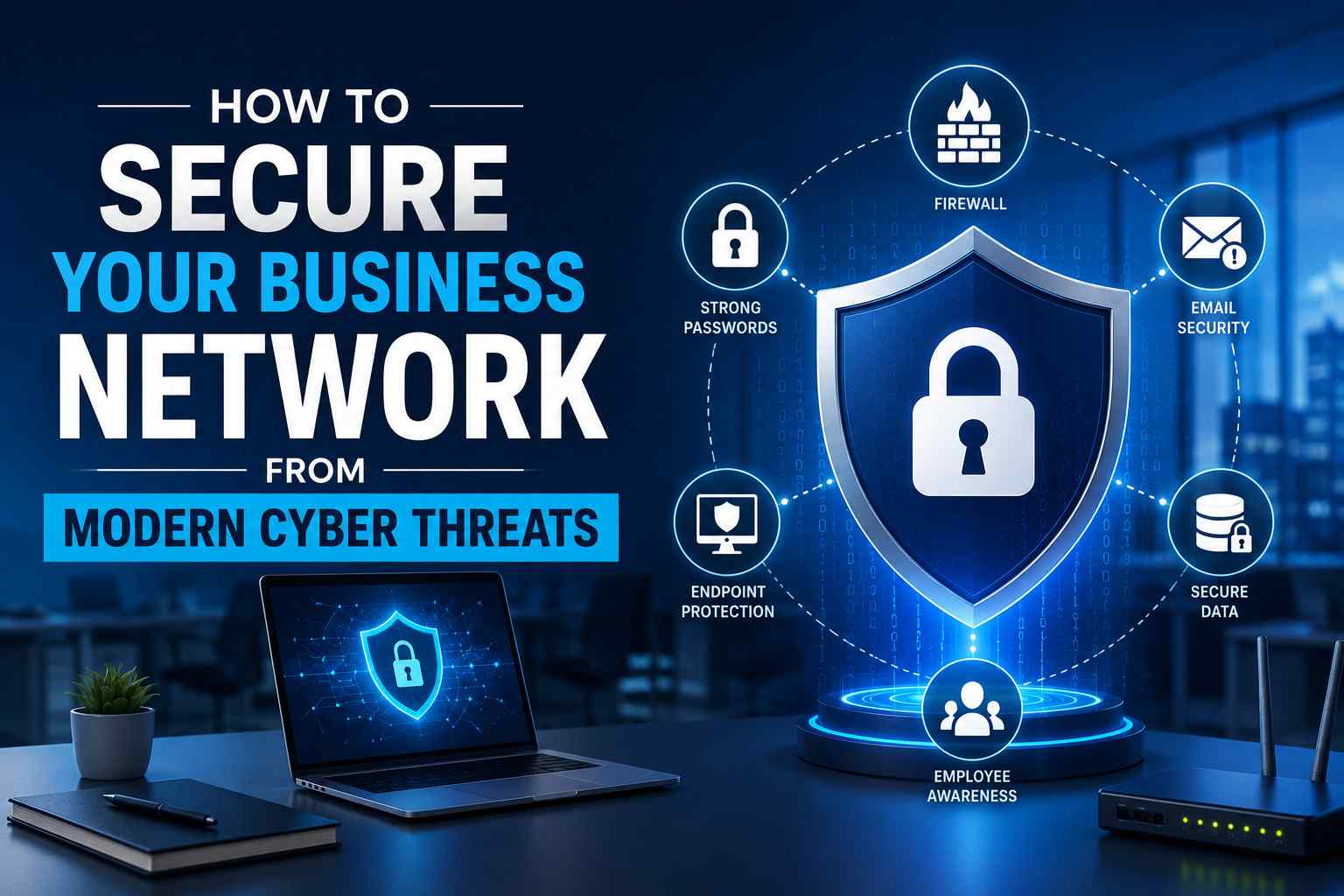
How to Secure Your Business Network from Modern Cyber Threats
In today’s connected business environment, cyber threats have become more advanced than ever before. Every organization, regardless of its size, relies on digital systems to manage communication, customer information, financial records, cloud applications, and day-to-day operations. While technology has made businesses faster and more productive, it has also created new opportunities for cybercriminals to exploit vulnerabilities. A single security incident can disrupt operations, damage customer trust, and result in significant financial losses.
Many business owners believe cyberattacks only target large enterprises, but statistics consistently show that small and medium-sized businesses are among the most common victims. Hackers often look for organizations with weak security measures because they are easier to penetrate. From ransomware and phishing attacks to insider threats and unsecured networks, modern businesses face a wide variety of risks that require a proactive security strategy rather than reactive fixes.
The good news is that building a secure business network does not have to be overly complicated. By understanding common threats and implementing the right combination of technology, policies, and employee awareness, organizations can significantly reduce their risk while creating a stable foundation for future growth.
Why Business Network Security Matters More Than Ever
A business network is much more than internet connectivity. It serves as the central infrastructure connecting employees, computers, servers, cloud platforms, security cameras, communication systems, and business applications. When this network is compromised, every connected device becomes vulnerable.
Modern cybercriminals are motivated by financial gain, data theft, corporate espionage, and even operational disruption. They continuously develop sophisticated techniques that bypass outdated security systems.
The impact of a cyberattack extends beyond temporary downtime. Businesses often experience:
- Financial losses from ransomware or fraud
- Customer data breaches
- Reputation damage
- Compliance violations
- Reduced employee productivity
- Expensive recovery costs
- Interrupted business operations
Instead of asking whether a cyberattack will happen, organizations should focus on how prepared they are when one occurs.
Understanding Modern Cyber Threats
Cyber threats have evolved dramatically over the past decade. Traditional antivirus software alone is no longer enough to defend today’s business environments.
Phishing Attacks

Phishing remains one of the most successful attack methods because it targets people rather than technology. Attackers create convincing emails, text messages, or fake websites that trick employees into revealing passwords or downloading malicious software.
Even a well-trained employee can occasionally be deceived by highly personalized phishing attempts.
Ransomware

Ransomware encrypts business data and demands payment before restoring access. In many cases, organizations suffer days or even weeks of downtime while recovering systems.
Regular backups reduce recovery time but preventing infection remains the best defense.
Malware

Malicious software can silently steal confidential information, monitor user activity, or provide attackers with remote access to company systems.
Many malware infections begin through infected email attachments or compromised websites.
Insider Threats

Not every cybersecurity risk comes from outside the organization. Employees may accidentally expose sensitive information through weak passwords, unauthorized software installations, or improper handling of company data.
Intentional insider attacks, although less common, can be equally damaging.
Weak Passwords

Simple or reused passwords remain one of the easiest ways for attackers to gain unauthorized access.
Businesses should require strong password policies combined with multi-factor authentication for all critical systems.
The Difference Between Reactive and Proactive Network Security
Many businesses only invest in cybersecurity after experiencing a security incident. This reactive approach often costs significantly more than prevention.
| Reactive Security | Proactive Security |
| Responds after attacks | Prevents attacks before they occur |
| Higher recovery costs | Lower long-term costs |
| Unexpected downtime | Improved business continuity |
| Data recovery challenges | Continuous monitoring |
| Customer trust affected | Strong customer confidence |
Organizations that continuously monitor, update, and improve their security posture are far more resilient against modern cyber threats.
Build a Strong Network Foundation
A secure business network begins with reliable infrastructure. Poor-quality hardware, outdated switches, unmanaged devices, and improperly configured equipment create unnecessary vulnerabilities.
Network segmentation is another important practice. Rather than placing every device on the same network, businesses should separate critical systems such as accounting, servers, security cameras, guest Wi-Fi, and employee workstations. This limits the movement of attackers if one area becomes compromised.
Reliable infrastructure also improves performance, making it easier for security tools to detect suspicious activity without creating unnecessary bottlenecks.
During infrastructure upgrades, many organizations partner with structured cabling companies Columbus to build organized, scalable network environments that improve both reliability and long-term security.
Secure Every Connected Device
Today’s businesses operate far more connected devices than ever before.
Desktop computers, laptops, smartphones, printers, wireless access points, IP phones, surveillance cameras, smart TVs, conference room equipment, and IoT devices all become potential entry points if left unsecured.
Every connected device should receive:
- Regular software updates
- Security patches
- Endpoint protection
- Access restrictions
- Device monitoring
- Strong authentication
Removing unused devices and disabling unnecessary services also reduces potential attack surfaces.
Protect Your Business Data
Business data is one of the most valuable assets an organization owns, making it a frequent target for cybercriminals. Customer information, financial records, employee files, and confidential business documents should be protected through multiple layers of security. Encryption helps keep sensitive information secure, while regular backups ensure data can be recovered quickly if an unexpected incident occurs. Businesses can strengthen their data protection strategy with Vortex IT Systems, which provides secure backup solutions, access management, and proactive security practices. Limiting employee access to only the information they need also reduces the risk of unauthorized access and accidental data exposure.
Employee Awareness Is Your First Line of Defense
Technology alone cannot stop every cyberattack.
Employees interact with emails, websites, cloud applications, and customer information every day. Proper security awareness training dramatically reduces the likelihood of successful attacks.
Training should include recognizing phishing emails, verifying suspicious requests, reporting unusual system behavior, creating strong passwords, avoiding unsecured public Wi-Fi, and handling confidential information responsibly.
Security awareness should become an ongoing process rather than a one-time training session.
When employees understand how cybercriminals operate, they become valuable contributors to the organization’s overall security strategy.
Network Infrastructure Supports Better Security
Many organizations focus only on firewalls and antivirus software while overlooking the physical infrastructure supporting their network.
Reliable cabling ensures stable communication between servers, switches, access points, storage systems, and other critical devices. Poor installations can introduce unnecessary downtime, troubleshooting complexity, and future expansion challenges.
Businesses planning long-term growth often evaluate fiber optic cable installation companies when upgrading network capacity because fiber offers higher bandwidth, lower latency, greater reliability, and improved performance for modern applications including cloud computing, video surveillance, and large-scale data transfers.
A well-designed physical network creates a stronger foundation for cybersecurity technologies to perform effectively.
Keep Your Systems Updated Before Hackers Get the Chance
Cybercriminals don’t always rely on complex hacking techniques. In many cases, they simply look for businesses running outdated software with known security flaws. Once these weaknesses become public, attackers often begin exploiting them within days, making delayed updates one of the biggest cybersecurity risks.
Every device connected to your business network—including computers, servers, firewalls, routers, cloud applications, and business software—should be updated regularly. Security patches not only fix bugs but also close vulnerabilities that attackers actively search for.
Instead of waiting until something goes wrong, businesses should adopt a proactive update strategy. Working with Managed IT Services Columbus helps ensure software patches, firmware updates, and security improvements are applied on time with minimal disruption to daily operations. Combined with routine monitoring and scheduled maintenance, this approach keeps your network protected, improves system performance, and significantly lowers the chances of a successful cyberattack.
This version reads more naturally, is more engaging for readers, and fits well in an SEO blog while incorporating the keyword only once.
Why Professional IT Support Makes a Difference
Managing cybersecurity internally can become challenging as businesses grow.
Technology changes rapidly, and attackers continuously develop new methods for bypassing traditional security controls.
Professional IT teams help organizations monitor networks, maintain hardware, install updates, manage backups, configure firewalls, respond to security incidents, and implement long-term cybersecurity strategies.
Businesses looking for dependable technology management often rely on Fast IT Support Services in Columbus to reduce downtime, strengthen network security, and ensure systems remain operational while allowing employees to focus on business growth rather than technical problems.
Conclusion
Modern cyber threats continue to evolve, making business network security more important than ever before. Every connected device, employee, application, and piece of infrastructure plays a role in protecting valuable business information. Organizations that combine secure network design, employee awareness, reliable infrastructure, continuous monitoring, strong authentication, regular updates, and professional IT management create a much stronger defense against cyberattacks.
Rather than waiting for a costly security incident, businesses should adopt a proactive cybersecurity strategy that strengthens every layer of their network. Investing in prevention today not only reduces future risks but also improves operational efficiency, customer trust, and long-term business resilience in an increasingly digital world.